

As world leaders work to curb global warming and meet climate goals set by the Paris Agreement, the shipping sector must also transition to zero emissions to reduce global greenhouse gas (GHG) emissions. Shipping accounts for approximately 3% of global GHG emissions, and its share could continue to rise. Electrifying vessels offer a promising pathway to reducing both GHG emissions and air pollution from the sector, with advances in battery technology and electric propulsion demonstrating that zero-emission vessels can meet demanding operational requirements. Yet, across regions, the transition faces common barriers, including high upfront costs, inadequate charging infrastructure, investment uncertainty and the need for supportive, long-term policies.
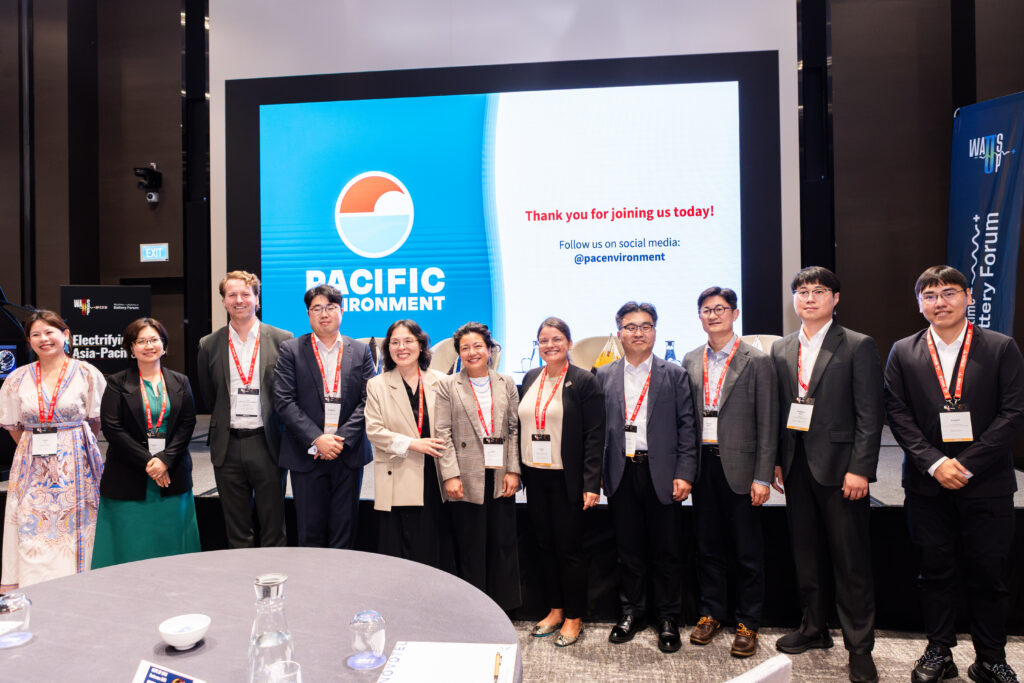
In September 2026, Pacific Environment hosted a networking reception at the WATTS UP APAC 2026 conference, held under the theme “Electrifying Asia-Pacific.” Organized by the Maritime Battery Forum in Singapore, the conference brought together policymakers, academia, industry and other key stakeholders to advance vessel electrification.
Pacific Environment also facilitated a special session at the main conference, bringing together perspectives from China, the Republic of Korea, Singapore and California. The session explored progress in vessel electrification, examined shared challenges and identified solutions to accelerate deployment. The discussion highlighted a central message: electric vessel technologies are advancing, but coordinated action on policy, infrastructure and financing is essential to move beyond successful demonstrations and scale up adoption.

Common challenges: Closing the gap between technology and deployment
One of the most significant barriers to vessel electrification is the high upfront cost of electric vessels compared with conventional diesel alternatives. Mr. Tay Yuan Sherng from the Maritime and Port Authority of Singapore (MPA) pointed out that electric harbor craft, can cost twice as much as diesel vessels, making operators cautious about investing in new technologies. Although electric vessels may offer lower operating costs over time and certainly provide other community benefits like cleaner ports and lower emissions, the initial investment remains a major obstacle to commercial adoption.
Charging infrastructure was another common challenge highlighted by participants. A persistent “chicken-and-egg” dilemma remains: shipowners are reluctant to invest in electric vessels without adequate charging infrastructure, while infrastructure providers hesitate to invest without sufficient demand. Local geography and operational requirements also shape infrastructure needs. For example, Korea’s coastal waters pose challenges for standard fixed-charging infrastructure due to extreme tidal ranges, inclined loading ramps and short turnaround times, explained Dr. Young-Shik Kim from Korea Research Institute of Ships & Oceans Engineering. The availability of high-power charging infrastructure also remains a major bottleneck to the widespread adoption of electric vessels. Mr. Zhihang Meng of the International Council on Clean Transportation (ICCT) illustrated the scale of the challenge: charging a 20 MWh (megawatt-hour) vessel in one hour would require 20 MW (megawatt) of charging capacity, equivalent to 400 household electric vehicles charging simultaneously.

Opportunities: Proven technologies and growing policy momentum
Despite these challenges, experiences across regions point to significant opportunities.
First, battery-electric propulsion is already demonstrating its suitability for particular vessel segments. Short-distance cargo ships, ferries operating on fixed routes, harbor craft and some fishing vessels have operational characteristics that make electrification especially promising. Predictable routes and regular schedules can help operators plan charging and energy use.
China’s growing electric vessel fleet demonstrates how policy support, technology and infrastructure can accelerate deployment. The country’s vessel scrapping incentive policy provides substantial financial support to shipowners who replace older vessels with new ones powered by electricity or alternative fuels such as methanol, hydrogen and ammonia. Regional governments are also installing high-power charging stations along planned green shipping routes.
These efforts are helping expand China’s electric fleet, which grew from four vessels in 2022 to 42 in 2025, with projects concentrated along the Yangtze River and the Beijing-Hangzhou Grand Canal. China has also deployed megawatt-scale electric vessels, including coastal container vessel with 19.6 MWh of battery capacity and an inland bulk carrier with 24 MWh.
Beyond reducing GHG emissions, electrification can improve air quality. The shipping sector is a significant source of transportation-related nitrogen oxide and particulate matter emissions. Replacing conventional engines with electric propulsion can therefore contribute to cleaner air as well as climate objectives.
Realizing these benefits at scale will depend in part on continued policy support. Across regions, governments are using different approaches to encourage the transition to cleaner vessels. China is using vessel replacement incentives and setting local electrification targets, Singapore has established requirements for new harbor craft entering operation by 2030, and California has progressively strengthened emissions rules for commercial harbor craft. Although the approaches differ, these measures demonstrate how governments can use regulatory frameworks to create demand for cleaner vessels.
Solutions: Aligning policy, infrastructure and investment
The forum discussions highlighted four shared priorities for accelerating the transition to electric vessels.
1. Combine early financial support with long-term regulatory certainty
- Reduce upfront costs and investment risks. Targeted subsidies and demonstration funding can help early adopters overcome high upfront costs and reduce the risks associated with new technologies.
- Provide predictable regulatory signals. Long-term emissions requirements and clear implementation timelines can help operators, ports and technology providers make investment decisions with confidence.
- Consider flexible market mechanisms. Regulators can use tools such as carbon pricing to complement regulation while accommodating technological developments.
2. Expand charging and battery-swapping infrastructure
Large-scale deployment of standardized, high-power charging infrastructure is essential to support electric vessel fleets. Where conventional charging is impractical, alternative solutions can help address geographical constraints and operational demands.
- Expand high-power charging. Coordinate investment in charging facilities with the deployment of electric vessels to ensure infrastructure keeps pace with demand.
- Explore battery-swapping. Korea’s “Swap-and-Go” concept offers a potential solution for locations where geography and environmental conditions make conventional charging challenging.
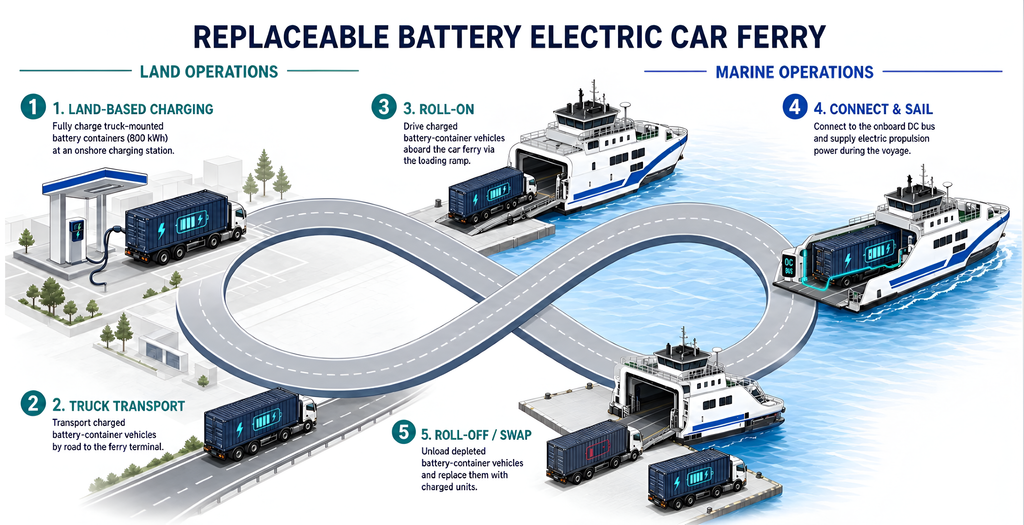
Coordinating investment in vessels, ports and charging facilities can help overcome market coordination challenges and prevent infrastructure shortages from becoming a bottleneck to electrification.
3. Demonstrate the commercial value of electrification
Building confidence in the business case for electric vessels is essential to wider adoption. Technology providers can help operators assess costs, benefits and investment risks through:
- Scenario-based analyses that compare operating conditions, upfront investment requirements and long-term returns.
- Scalable infrastructure systems that allow capacity to expand as vessel requirements evolve, reducing the need for costly redesigns.
4. Strengthen research and evidence-based policymaking
Further research and real-world operational evidence can help address safety concerns, inform policy and build confidence in electric propulsion. Key priorities include:
- Improving marine battery safety and developing fire-suppression solutions suited to maritime environments.
- Collecting operational data from demonstration projects to assess performance under real-world conditions.
- Using this evidence to inform safety standards, guide infrastructure planning and support investment decisions.
These cross-regional lessons reinforce the importance of a coordinated approach that combines targeted early-stage funding, sustained regulatory measures, scalable infrastructure and evidence-based planning.
Achieving this will require stronger collaboration among governments, ports, vessel operators, technology providers and researchers. By aligning policy ambition with practical infrastructure needs and commercial realities, stakeholders can accelerate the transition from individual demonstration projects to broader adoption of zero-emission maritime transport.
A clear policy signal in Singapore
On October 14, 2026, Singapore’s Maritime and Port Authority (MPA) announced the Early Adopter Scheme for Electric Harbour Craft (EASE), offering harbor craft operators in the country of up to S$250,000 per vessel to support the transition to electric vessels. By helping to offset upfront costs, the grant aims to catalyze early demand and encourage more operators to make the switch to electric vessels.
Singapore’s initiative reflects a broader lesson from experiences across Korea, China, California and Singapore: advancing maritime electrification requires more than technological progress. Clear policy signals, targeted financial support and investment in charging infrastructure are essential to turn promising technologies into widespread adoption.
Explore Pacific Environment’s sustainable shipping work to learn how we’re advancing cleaner, more climate-friendly maritime transport.


