
The world has made an ambitious commitment to protect and conserve at least 30% of the ocean by 2030 (otherwise known as 30×30). But with only four years to go, the challenge is increasingly clear — protection on paper is not enough. Marine areas need to be effectively managed, supported by communities, and backed by action on the ground.
Today, about 10% of the ocean is designated as protected or conserved, while just 3.5% is considered effectively protected. That gap shaped many of the conversations at the U.N. Biodiversity Conference (COP17) in Yerevan, Armenia, where governments, conservation organizations, funders, scientists and community practitioners focused not only on expanding protection, but on making sure it works.
COP17 also marked the first global review of progress under the Kunming-Montreal Global Biodiversity Framework, which includes four goals and 23 targets to be achieved by 2030 to ensure that at least 30% of degraded terrestrial, freshwater, marine and coastal ecosystems are under effective restoration. The findings show that while nearly 90% of countries have established national biodiversity targets, fewer than half of the targets assessed are currently on track. A new global restoration assessment released during the conference also found that marine and coastal ecosystems are lagging behind terrestrial restoration targets. Together, these findings reinforced a message we heard throughout COP17: the next phase of 30×30 must focus not only on commitments, but on effective implementation.
From protected areas to protected ecosystems
Marine protected areas (MPAs) and Other Effective Area-Based Conservation Measures (OECMs) — which are areas that are outside of formally designated protected areas that are governed and managed for biodiversity conservation — can play an important role in meeting global biodiversity targets. But their success depends on what happens after an area is designated.
Many of these steps depend on effective implementation of the 30×30 commitments. Many questions need to be answered such as: Who makes decisions? Who monitors the ecosystem? Do local communities have meaningful authority? Is there enough funding for long-term management? And, most importantly, are biodiversity and livelihoods actually improving?
At COP17, conversations focused on measurable outcomes rather than hectares alone. For Pacific Environment, that reinforces the importance of monitoring and evaluation that can show what is changing on the ground, while keeping data collection practical and useful for local communities.
Conservation works better when communities lead it
Another message was equally clear: Communities cannot be an afterthought. The people who live closest to marine ecosystems need to play a meaningful role in shaping how MPAs and OECMs are protected and managed.
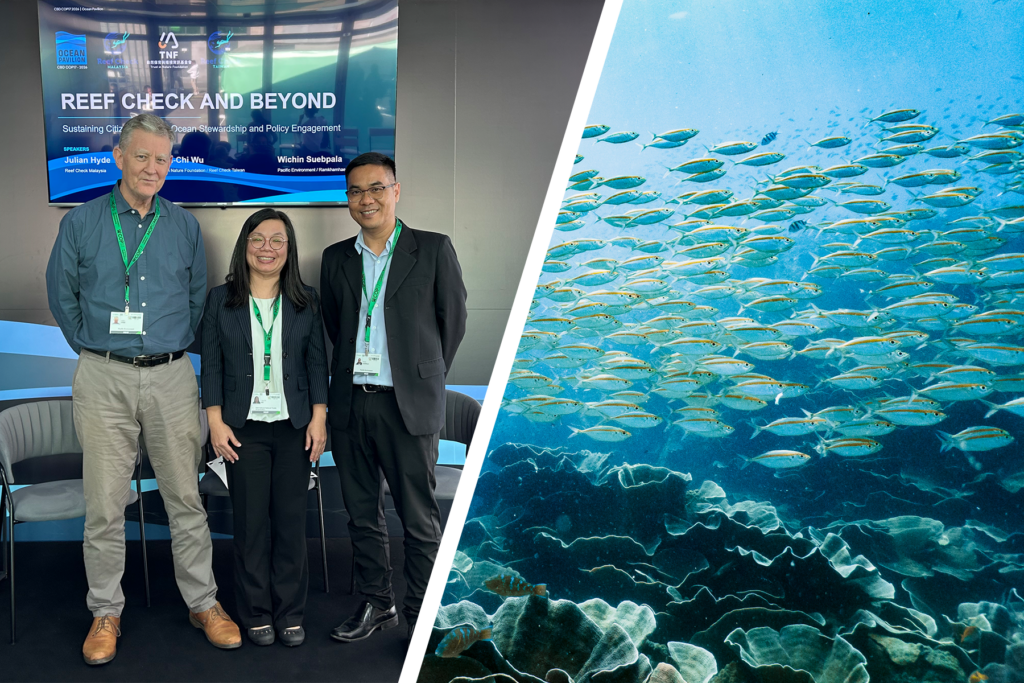
Pacific Environment’s Thailand Marine Project Manager Dr. Wichin Suebpala joined a COP17 panel on locally-led marine conservation and shared our work in Trat Province, Thailand. There Pacific Environment is working with local authorities, fishers and conservation organizations to advance community-led OECMs.
Alongside Wichin, Reef Check Malaysia CEO Julian Hyde discussed how OECMs can offer a different approach to conservation: Recognizing the work of communities that have cared for marine ecosystems for generations and ensuring their role in decisions about their future.
The communities we work with already have a strong interest in conserving the marine ecosystems they depend on and are supporting efforts to formally recognize these areas as OECMs under the country’s 30×30 commitments. To take our work to the next level, we are also engaging young people so they can play an active role in the future management and protection of these ecosystems. Just last month, Pacific Environment organized “Learn, Explore, Analyze, and Communicate Effectively,” in collaboration with Ko Kut Wittayakhom School, Ko Kut District, Trat Province. A total of 30 high school students participated in the camp. The objectives were to enhance their understanding of the importance of marine and coastal resources on Ko Kut Island, Thailand, develop their knowledge of the ecological connectivity among terrestrial forests, mangroves, sandy beaches, seagrass beds, coral reefs and underwater pinnacles. The camp also focused on developing students’ field investigation skills, basic data analysis abilities, environmental awareness, and capacity to communicate marine conservation knowledge to tourists and local communities.
A community-based approach can be especially important in places where traditional conservation measures have limited local use without giving communities an equal voice in management. Both speakers also highlighted the pressure tourism can place on marine ecosystems and the need to manage visitor capacity in ways that protect nature while supporting local livelihoods.
Protecting what remains — and restoring what has been lost
We also heard growing recognition that conservation alone may not always be enough.
Protecting healthy ecosystems remains essential, but degraded coral reefs, mangroves and other coastal habitats may also need targeted restoration and stronger efforts to reduce the threats that caused their decline. The conversation is shifting from how much ocean we protect to whether ecosystems are resilient, connected and able to recover.
Restoration can be expensive and technically demanding, and it will not be the right solution everywhere. But where ecosystems have already been heavily degraded, combining effective protection with science-based restoration could help strengthen biodiversity and climate resilience.
Turning global commitments into local action
Pacific Environment’s ocean conservation work is focused on turning global commitments into practical, locally-led action. In Thailand, we are working to advance locally-led OECMs and connect lessons from communities in Trat with national conservation policy. In the Philippines, we are supporting efforts to strengthen community-led marine protection and management. Across Southeast Asia, we are exploring how lessons from different countries can help governments, communities and conservation organizations develop approaches that are not only locally appropriate, but capable of being replicated and sustained.
COP17 reinforced that there is no single solution to the ocean protection gap
We need strong policy. We need science. We need sustainable financing. We need restoration where ecosystems require it. But above all, we need conservation that works in practice — with communities not simply participating in decisions but also shaping them.
As 2030 approaches, the challenge is no longer simply making bigger commitments. It is turning the commitments we already have into healthier ecosystems, stronger local institutions and marine conservation that lasts.


