In early December, the world’s shipping regulator, the International Maritime Organization (IMO), will once again weigh the adoption of the Net-Zero Framework. Shipowners are split. The industry is asking for a strong market signal. And the decision that was supposed to happen in October 2025 was pushed back a year.
So, we asked: What is the cost of inaction in moving shipping to zero-emissions fuels cost shipowners in the Republic of Korea? A joint analysis (Korean translation) by Korea Maritime & Ocean University’s Green Ship Technology Laboratory (KMOU GSTL), University College London (UCL) and RMI, complemented by Japan-focused research conducted by the Institute for Global Environmental Strategies (IGES), finds that when an owner delays a vessel order and delivery from 2029 to 2032, that we expect roughly 33% to 97% higher lifetime costs.
What is the solution? Early investment in vessels capable of using green fuels such as ammonia and methanol can provide a more economical long-term transition pathway as international shipping regulations tighten. International regulations towards a zero-emissions future require that the shipowner take both near- and future-costs into account. The Net-Zero Framework can fundamentally change vessel investment economics and strengthen the business case for earlier adoption of ships capable of using green fuels such as ammonia and methanol.
Under the IMO’s Net-Zero Framework, ocean going ships that burn fossil fuels are significantly more expensive to own, roughly 19-76% more over their lifetime. Ships that run on ammonia or methanol can be much more inexpensive to operate by about 14-28%.
We also found that lowering financing could significantly change the calculus for the viability and speed of the transition to green fuels in shipping for the Republic of Korea. Under the assumptions used in the study, the modeled Korean weighted average cost of capital (WACC) is 9.4%, compared with 4.3% in the Japanese case. The modeling shows that lower financing costs can accelerate the point at which ammonia-capable vessels become economically attractive. Republic of Korea’s maritime transition will require not only technological development, but also policies that reduce financing costs for green vessels, expand government-backed guarantees and risk-sharing mechanisms, improve tax incentives, and support access to competitively priced green fuels.
How has this research been received?
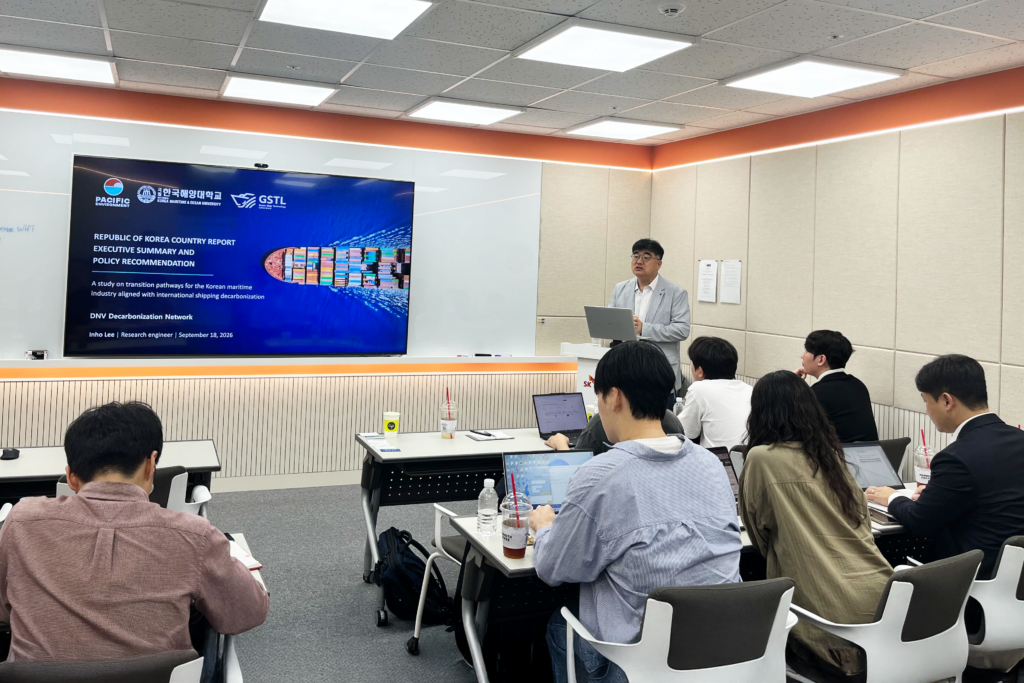
The research was presented at a policy forum on the carbon-neutral transition of Korea’s shipbuilding and shipping industries and the future of small and medium-sized shipping companies. This generated important discussion about the challenges smaller operators face in renewing their fleets and the policy and financing mechanisms needed to support their transition.
The findings were also shared through the DNV Korea Decarbonization Network, bringing the analysis into discussions with stakeholders across Korea’s maritime sector, including major shipowners, shipbuilders, classification and port stakeholders.
These engagements help connect the research with practical discussions about how international decarbonization rules will affect vessel investment, fuel choices and fleet transition strategies in Korea.
What’s next?
We realize this transition will require complementary domestic policies that lower financing and upfront investment barriers and enable Korean shipping companies — including small and medium-sized operators — to invest in the next generation of green vessels. Pacific Environment will continue to work with international policy makers, ship owners and Korea’s maritime leaders to help create a long-term pathway to a zero-emissions future. And we look forward to collaborating with policy makers and industry at the IMO meetings this November and December towards establishing policy that creates market certainty for all involved.